
Matched pairs and side stones
Pear Shaped Diamond Side Stones and Matched Pairs
Finding a reliable supplier of Pear Cuts is no simple matter, be it due to quantities, pricing, or quality of work. We’re able to differentiate our Pear Shaped Diamonds and offer them in matching pairs down to a millimeter.
Memo and Net 30 terms for US trade accounts, with insured next-day delivery.

The specification
Our Pear Cut Diamond Side Stones
We supply calibrated Pear side stones, ready to set, across this range
Colors range from D to I
Our Pear Cut Side Stone product line is used by both wholesalers and jewelers, commonly incorporating them in a Teardrop Shaped Engagement Ring, Anniversary Rings, Three Stone Rings, Vintage and Antique Rings, Cathedral and many more.
Don’t hesitate to contact us for more info, consultations, and custom orders.
A Closer Look at Pear Cut Diamonds


A CHILD BORN FROM LOVE – THE PEAR CUT
The Pear Cut is a child born from the beloved classic Round Cut and the Marquise. A surprising match that gave birth to a true masterpiece known as the Pear, or Tear Drop Cut Diamond. The Pear Cut offers some unique advantages, many of which are related to its rich ancestry. One such example is the number of facets (58) which takes after the king of all diamond cut, the brilliant round. The elongated and stylish elegance of the Pear also gives the appearance of being larger than it actually is.
Finding a good Pear Cut Diamond is no Easy Task
It’s always recommended to go through established manufacturers and importers for all diamond purchases, be it wholesale or single purchases due to pricing, and most importantly quality assurances and guidance, and that’s especially important when purchasing a Pear Cut Diamond. A well cut Pear Diamond is hard to come by, they are often too long, too short, not rounded enough, or too rounded. It’s no surprise that the GIA chooses to opt out of grading them!
Ideal Settings for Pear Cut Diamonds
With all of its beauty and allure, the Pear Cut Diamond is considered among the gentler fancy diamond shapes out there due to its sharp tip point. That’s why proper settings are highly important, to both maximize its beauty and protect it from any potential damage when used as a center stone. When it comes to the settings that offer the most significant protection it’s hard to argue that the Bezel Settings is the best choice surrounding the entirety of the piece in protective metal. While the Bezel is the safest choice, it does have certain drawbacks like making the center stone appear smaller and keeping a good portion of it hidden. Another way to go about it is to use the classic 6 Prong Setting with an added V tip, or even a Halo Ring Setting. Both enrich the appeal of the Pear Cut Diamond much better but are somewhat less protective. The Pear Cut also make for wonderful side stones, especially when combined with the Round Brilliant Cut Diamond.
Side Stone Combinations for a Pear Cut Center Stone
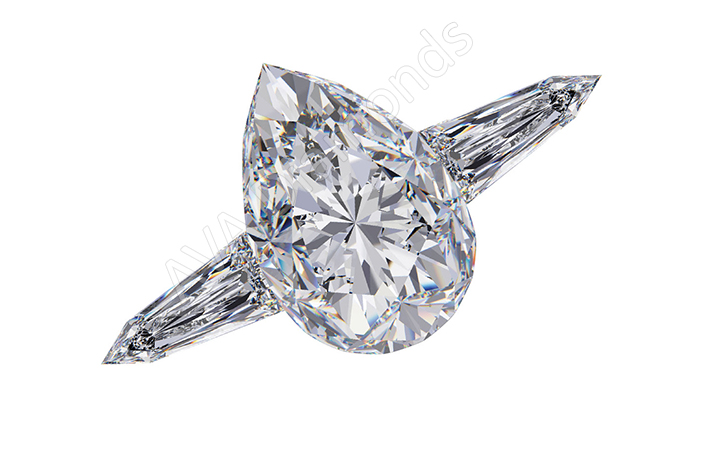
When it comes to the Pear Shape in Three Stone Rings, the side stone you opt for have a tremendous presence, and as such choosing one that best suits your own taste should not be taken lightly. Below are some great combinations, including kite, tapered bullets, shields, and heart shaped side stones. When it comes to the Pear Shape in Three Stone Rings, the side stone you opt for have a tremendous presence, and as such




Stunning Examples of Pear Shaped Diamond Jewelry for Inspiration


Frequently Asked Questions About Pear Side Stones
What is a pear cut diamond?
A pear is a brilliant cut shaped like a teardrop, rounded at one end and pointed at the other. As a side stone it adds a soft, flowing line, and the point usually faces toward or away from the center stone to lead the eye. It combines the sparkle of a round with the length of a marquise.
Which center stones do pear side stones suit?
They pair well with round, oval, pear, and marquise centers, where the curves flow together naturally. A pair of pears set point-inward frames a round or oval center beautifully. They suit designs that want softness and movement rather than sharp geometry.
Do pear cuts have a bow tie?
They can. Like other elongated brilliants, a pear may show a bow tie, the dark band across its middle, depending on how it is cut. When matching a pair of pears, the bow ties have to match as well as the outlines, because two pears with different bow ties will look different once set beside the center stone. It is a real matching challenge.
Why do pear points need protecting?
The point of a pear is its most exposed and vulnerable part and can chip if left unset, so it is normally protected by a prong or tucked into the setting. As side stones the points are usually oriented toward the center stone or against metal. Worth flagging to whoever sets the ring.
What is the difference between a pear and a half moon as a side stone?
A pear is a full teardrop with a point, so it reads as a distinct stone with its own shape. A half moon is a simpler straight-and-curved side stone that sits quietly against the center. Pears make more of a statement, half moons are more of a supporting frame. The choice depends on how much the side stones should draw attention.
Sizing, cutting style and the center stones this shape suits are covered in our guide to choosing side stones.
Pairs well with related side stone cuts
The same shape is cut as a complete row in our pear cut diamond layouts.


